Case Study 1
Cellular Concrete Tank Foundation
Background
In the design phase of an oil sand SAGD project, the client requested to change the conventional storage tank foundation to a more ecconomical design. The previous design was gravel pad tank foundations. The main purpose was for reducing the material cost, construction cost and schedule. However, this change casued several other technical concerns and difficulties. The question was raised to some our structural engineers. A more optimized and structurally sound design is required.
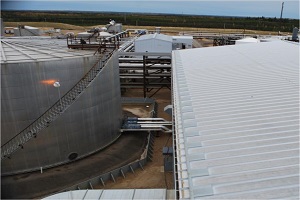
Analysis
The common storage tank foundations are either gravel pad or reinforced concrete ring beam. Both of those two options were not acceptable by the client. The following are the options that we compared.1. Gravel Pad
Due to the high material cost and availability issues, the gravel material and construction cost, this option was first ruled out by client.2. Concrete Ring Beam
Concrete ring beam option was studied. The material cost is lower than gravel pad. The weight of the concrete ring beam can be utilized to resist the frost heaving forces. Technically that's an idea solution. However, the constrution is complicated and much longer time is required. The construction includes excavation, shoring, formwork, rebar installation, pouring concrete, protection for curing in low tempreture, removing formwork, etc. Those extra steps may significantly affect the overall project schedule.3. Cellular Concrete
Cellular concrete pad foundation was our next direction to study. The design was simple, about one meter thick celluar concrete cylinder built on ground level, restrained by corrugated steel panels. The material cost is much less than gravel pad or ring beam. The construction is much simpler. Schedule advantage is also obvious. The client became more and more interested in the celluar concrete solution. Some technical issues must be addressed first before we can proceed to this solution.Challenges and Solutions
Same as other new design solutions, there are technical issues need to be resolved. Many other engineers prefer to stick with the conventional options which have been proved sound by previously built projects. However, the technologies are changing, the market situation is changing, responsive engineers should take challenges and creat new designs for better interest of the client and the public. After throughly study the cellular concrete design, our engineers pointed out following potential issues and provided inovative solutions accordingly.
1. Frost Heaving
Since the celluar concrete is light weight, the frost heaving became a concern. Frost heaving is an upwards swelling of soil during freezing conditions. When a tank is empty during winter, the weight for resisting the frost heaving is only the self weight of tank steel and the cellular concrete. That is far less than enough. The heaving may lift up the tank and potentially damage the tank and the attached pipes. We provided steel pipe piles solution to resolve this concern. The celluar concrete itself can not hold the piles while in tension. Long anchor rods were used to connect the piles and the tank. When frost heaving in action, the cellular concrete is under compression. The heaving force is then transfered to the tank, and balanced by the piles through the anchor rods. Steel pipe piles add some cost but still economical comparing to other solutions.2. Tank Settlement
The utilization of piles cased another issue. The geotechnical report suggested that the storage tanks are expected to settle for up to 10 inches. The piles can not resist the settlement becasue the numbers are limited for cost-effectiveness considerations. When the tank and the cellular concrete settle together, the celluar concrete foundation may break out or be punched. We worked out an inovative solution for that issue. We designed 10 inch thick void form locally on top of the piles. That creates a practical void space and makes the piles tension only. When tank settles, the void form will be compressed instead of breaking the cellular concrete.3. Containment Liner
The storage tanks are located inside a dyked tank farm. Liners are installed underground and around dyke walls for the secondary containment requirements. The tank settle ment may break the liner. Moreover, the corrugated steel panels may cut through the liners. Firstly, flexible joints were designed around each tank. That allows the tank to settle without damaging the liner. Secondly, precast blocks were provided under the corrugated panels to prevent them cut into the liners.4. Cellular Concrete Local Crushing
Cellular concrte is more often used as a kind of filling material. The mechanical properties are not very well guaranteed. The cellular concrete directly under the wall of the tanks may possibly be locally crushed. That could also be a safety issue for production. We designed a 4 inch thick normal weight concrete ring on top of the cellular concrete along the edge.That significantly improved the integrity of the cellular concrete. With a minor extra cost, the overall safety and useability is improved.Conclusion
This cellular concrete foundation design is new and inovative. It significantly reduced the TIC (cost) and helped the tight construction schedule. Both the client and the general contractor were happy with this new design.